In Asia, the role of social media as the main catalyst for civic engagement is declining. What can community builders do to help people connect?
The digital front line
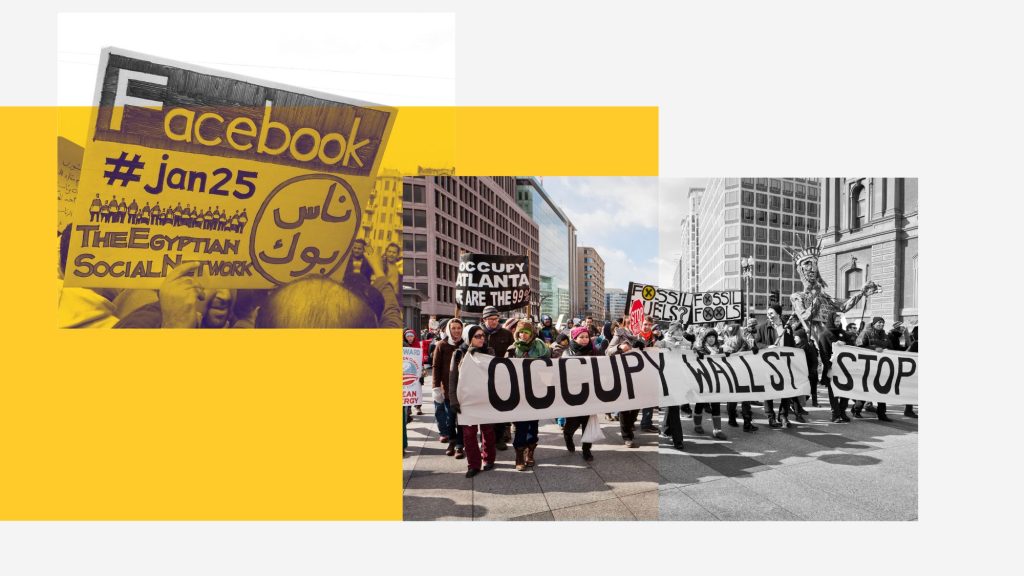
Social media played a critical role in Egypt’s Arab Spring and Occupy Wall Street in 2011, enabling activists to mobilise protests and share uncensored information. Its influence persisted through Hong Kong’s 2019 pro-democracy protests and continues today with Ukraine's war, despite increasing challenges as authorities censor platforms and use advanced tools to suppress digital dissent.
Photo: Alamy / SOPA Images
It appears 2011 was the last time people held hope about social media and its transformative impact. That year was a pivotal year for global social movements. Social media allowed revolutionary aspirations to resonate during the Arab Spring.1 Egyptian protesters generated 230,000 tweets per day, setting up 32,000 Facebook groups and 14,000 Facebook pages in the two weeks leading up to the Tahrir Square protests in Cairo.
Twitter prided itself on being the public square for social conversations then, as it drove political discourse in countries all over the world. 1 in every 500 hashtags globally was related to Occupy Wall Street at its peak,2 as Twitter functioned as a coordination hub.
Back home in Singapore, social media was lauded as the equaliser3 that changed an election. That year, the Workers’ Party wrested a group representation constituency (GRC) from the ruling PAP, marking a historic first in what analysts quickly dubbed the “Social Media Election.” A brand-new electorate was now able to access and contribute to citizen journalism websites like The Online Citizen, interact with smaller opposition parties, and explore new ideas.
I was merely 18 then, watching the world around me change as a teenager, tweet by tweet, photo by photo, essay by essay. Images of crowds kept me enthralled as I stayed up late to prepare for my A Level exams; I would read about them as examples I could cite in my essays.
#ONLINE, STORIES ABOUT INEQUALITY AND OPPRESSION RALLIED PEOPLE TO THEIR CAUSE — A FIGHT TO BE FREE.
The digital front line
Social media played a critical role in Egypt’s Arab Spring and Occupy Wall Street in 2011, enabling activists to mobilise protests and share uncensored information. Its influence persisted through Hong Kong’s 2019 pro-democracy protests and continues today with Ukraine's war, despite increasing challenges as authorities censor platforms and use advanced tools to suppress digital dissent.
Photo: Alamy / SOPA Images
I learnt from my mentor back then that it was key to craft a good narrative. As he used to say, a good story would triumph.
Online, stories about inequality and oppression rallied people to their cause — a fight to be free. It was this spirit that led me into journalism. I joined The Online Citizen as a junior writer in 2012, engaging with people who felt ignored by the government and mainstream media.
THE DARKNESS AND THE NOISE
The world has changed since then.
The commercialisation of social media — a process that was arguably inevitable — has led to a gradual erosion of trust in society, as disinformation and misinformation are now rampant.
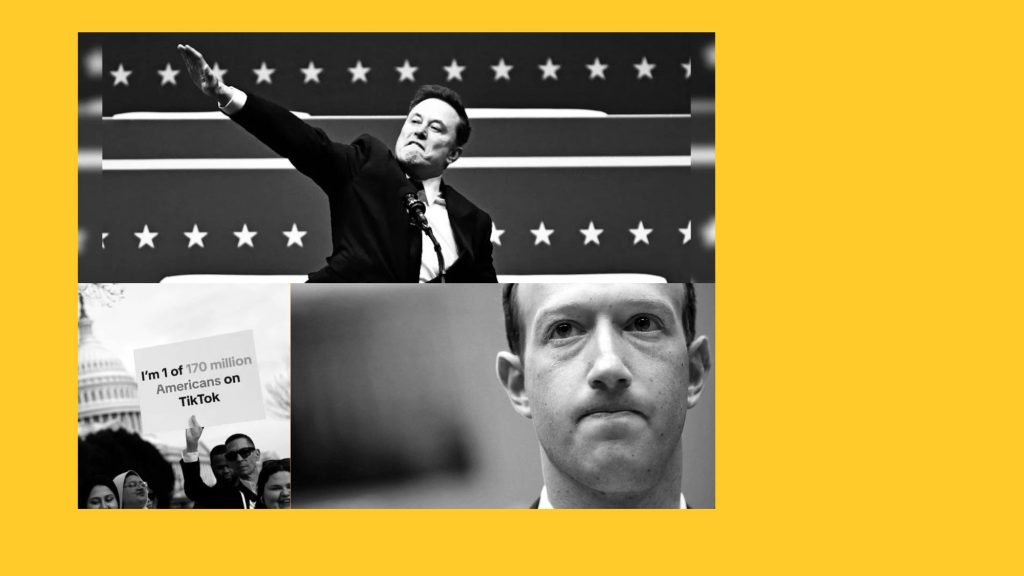
Twitter, now known as X, has seen its reputation as the world’s town square crumble, as users pay for influence and artificially boost their tweets; its chairman, Elon Musk, has used the platform to spread misinformation, reinstating alt-right and neo-Nazi accounts4 and allowing both X and its AI assistant Grok to amplify hard-right conservative views.5
#THE ANONYMITY OF THE INTERNET MEANS WE NO LONGER SEE OTHERS AS INDIVIDUALS BUT AS INTERCHANGEABLE MEMBERS OF ‘TRIBES’.
Meta, which owns Facebook and Instagram, has not emerged from the shadow cast by the Cambridge Analytica scandal, following the revelation that a British consulting firm harvested personal data from 87 million Facebook users without their consent. Facebook has also faced content moderation issues, with an Amnesty International report6 in 2022 finding that the platform amplified hate ahead of a 2017 massacre of Rohingya in Myanmar.
Social media has been accused7 of amplifying political polarisation and hostility. The relative anonymity of the Internet has meant that we no longer see others as individuals but as interchangeable members of ‘tribes’ — Democrats, Republicans, antiestablishment, leftists, Nazis, you name it.
Algorithms and influence
Social media giants like Facebook, X, and TikTok play an increasingly prominent role in political discourse, shaping what content is seen, how far it spreads, and how users engage. Their impact on public opinion and elections has drawn criticism for enabling misinformation, deepening divisions, and amplifying polarising or extreme voices.
And then there are the authoritarians who have exploited social media’s ability to spread misinformation. Bots have been used to spread falsehoods and discredit political opponents, as dictators use claims of ‘fake news’ to discredit the truth.
As governments deploy propaganda to manipulate narratives about their political enemies, block websites, and launch investigations on social media users while activists hide and journalists flee, I wonder what my role is as a journalist and as a citizen of the world.
SPEAK SOFTLY
As a child, I was told that being the loudest didn’t guarantee I would win.
My father would tell you that I was a bratty, odd child — one who was quiet in school but always got into trouble at home. Having three sisters meant I constantly had to compete for my parents’ attention, which, in turn, fed my loud and boisterous personality. I had difficulty speaking and communicating as a child, often stammering and stuttering during English lessons, and my thoughts were frequently disorganised and fragmented.
So, to be heard, I worked hard to learn how others communicated.
I practised speaking with anyone willing to listen — teachers, friends — and I read widely, learning to reason. I learnt to express sympathy and empathy, and to engage people on their level. I learnt to explain, to educate, and to understand my audience.
But, as I grew older, I also realised that the loudest people tend to win.
Trump’s disinformation campaigns overwhelmed newspapers and fact-checkers, and even as journalists tried to keep up, the US President often maintained full control of the narrative and the audience.
It’s no surprise that, in the internet age, outrage now fuels our attention economy. The words ‘wokeness’ and ‘cancel culture’ are used to downplay demands for social justice and accountability. Polls suggest people are seemingly more polarised, and social media acts more as a distorting prism than a mirror, says political psychologist Antoine Marie.8
This led me to wonder: how can we sustain a world we all share? How can we help people connect?
Tribes in the feed
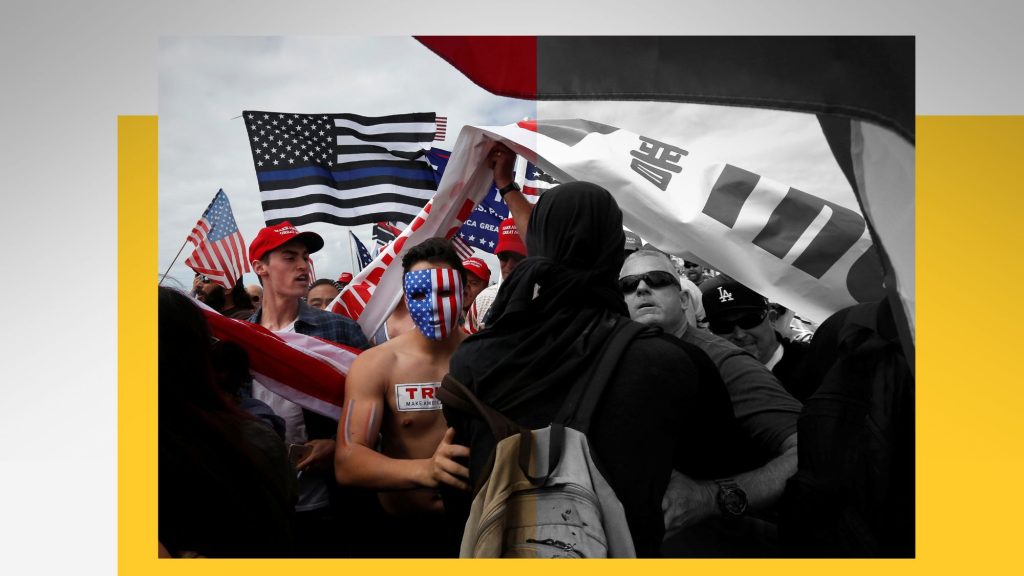
Clashes between pro- and anti-Trump groups reflect America’s growing political divide. As platforms reward outrage over dialogue, political differences harden, and online tribalism increasingly manifests as real-world confrontation and hostility..
Photo: Reuters / Patrick T Fallon
THE PERSONAL
The attention economy, as defined by research fellow Matthew Crawford, sees human attention as a finite resource. Crawford theorises that an individual has only a limited amount of attention, yet we often overlook the need to claim our attentional resources for ourselves. We take our attention for granted, especially online, where we are continually bombarded with carefully crafted messaging and branding.
On social media platforms, clips that garner attention and generate engagement are rewarded and broadcast further to larger audiences. This demonstrates the attention economy in action: the more time we spend on social media, the more it offers us content that keeps us engaged.
All this doesn’t mean that we no longer desire human connections. We humans still crave a sense of authenticity — the personal.
With the rapid democratisation of media and smartphones reducing the costs of content creation, community builders in the 21st century can now present themselves without needing to go through traditional gatekeepers. Meanwhile, as platforms consistently favour shorter video formats, community organisers are now compelled to create simple, genuine videos that feel authentic.
It’s this authenticity that has made platforms like TikTok and Instagram some of the most influential for social change. TikTok creates micro-subcultures, allowing community builders to reach audiences they previously could not reach.
#ALL THIS DOESN’T MEAN THAT WE NO LONGER DESIRE HUMAN CONNECTIONS. WE HUMANS STILL CRAVE A SENSE OF AUTHENTICITY — THE PERSONAL.
In Asia, for instance, social media provides women with unique opportunities for self-expression despite cultural restrictions. Among them are advocates in Sri Lanka who have promoted meaningful representation of women in the media and public spaces through social media, using Instagram to challenge unattainable beauty standards.
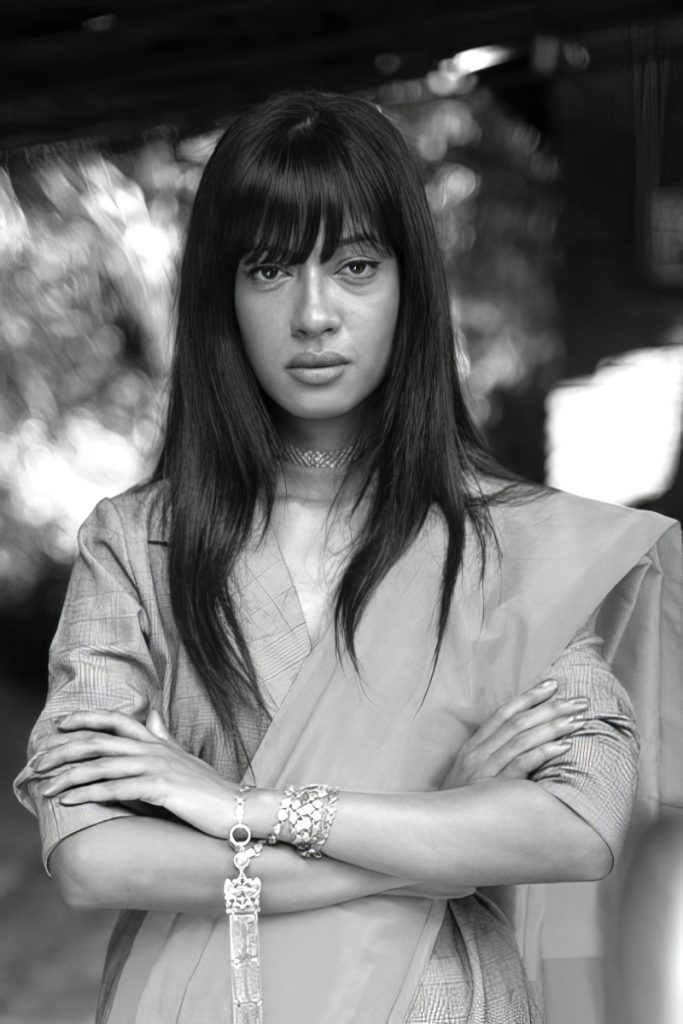
Kalpanee Gunawardana, a business owner, consultant, and advocate who studied law in Bristol, has worked to oppose skin-lightening products, such as Fair and Lovely (now Glow and Lovely). These products have historically been linked to colourism and discrimination.
Gunawardana grew up during Sri Lanka’s turbulent civil war and witnessed colourism both abroad and at home. To her, the issues Sri Lanka faces — from colourism to poverty — are deeply interconnected. “I had an academic background that allows me to discuss structural issues and point out that these things are interlinked. They don’t exist in silos.”
Being in a nexus of privilege — having worked on campaigns for Sunsilk and being exposed to modelling and evolving beauty standards during a time when conversations about diversity and inclusion were gaining prominence in the early 2000s — made her feel the need to speak out. Instagram has been the main platform through which she connects with communities beyond the silos and restrictions on other platforms.
“If somebody wants to be upwardly mobile in existing circumstances, the fairer you are, the better the job you’re going to get. It was because of my education and experience that I had the language to say, ‘Okay, this is not right.’ I’d start a conversation, and people would write back,” Gunawardana told me. “We have people writing in about their experiences, and that’s sort of how we grew. We need to talk about power, but really looking at structures and not people, and move the conversation from there.”
Advocate Kalpanee Gunawardana uses Instagram to combat harmful beauty standards and colourism.
Source: Calvin Chinthaka
Malala on activism that lasts
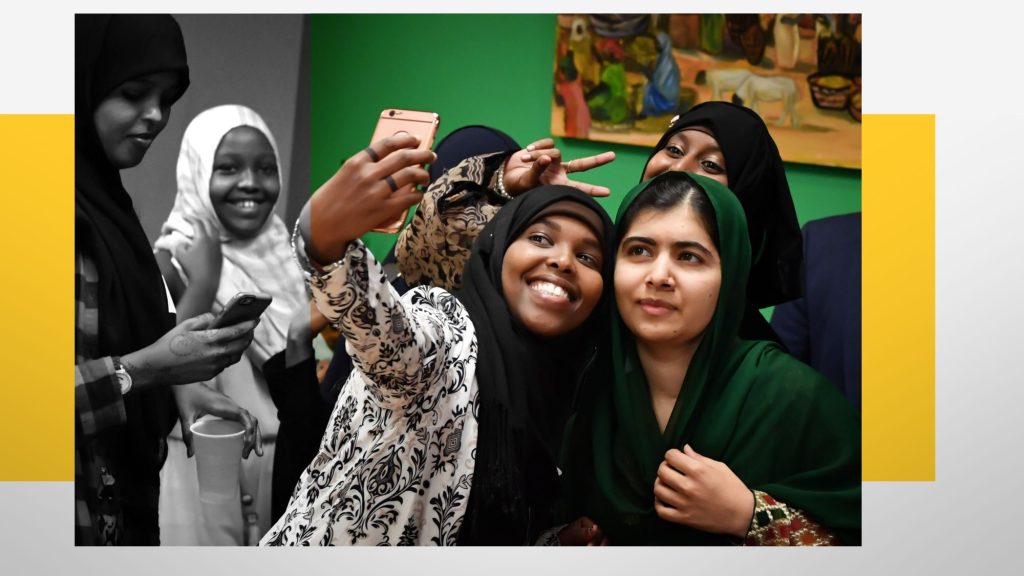
Education activist Malala Yousafzai acknowledges social media’s powerful role in activism, highlighting its ability to raise awareness and build connections. But she stresses that genuine change requires committed offline efforts, urging activists to translate digital advocacy into real-world actions and meaningful policy outcomes.
Photo: Alamy / ZUMA Press Inc
THE POLITICAL
Despite the increasing number of content creators, advocates, and community organisers displaying their authentic selves on social media, we still see an alarming rise in misinformation across all platforms.
Part of this is due to the democratisation of media, making it cheaper and much more straightforward to spread misinformation on the internet. Misinformation and disinformation travel much faster and farther than the truth. Studies show that before people can muster the resources to debunk false information, significant damage can already have been done by the rapid spread of falsehoods.
A study of rumour cascades9 on Twitter (now X) between 2006 and 2017 found that the top 1% of rumours reach between 1,000 and 100,000 people, whereas posts debunking these rumours rarely spread to more than 1,000. One can only imagine how quickly misinformation can spread today, given how X’s owner, Elon Musk, has continually spread deceptive material on his platform10 while dismantling efforts to moderate content on X.
Other platforms are not immune — TikTok,11 Instagram12 and Facebook13 all face similar challenges, despite genuine efforts to fact-check.
The extent of polarisation we observe today has been made possible by technology, according to Shobha Avadhani, a senior lecturer at the Department of Communications and New Media at the National University of Singapore. She believes digital capitalism and the drive for clicks have led to increasingly provocative content, resulting in a fracturing of our online public sphere.
Disinformation exploits our emotions to persuade us to share and spread it, and in the absence of credible curation and editorial oversight, we end up relying on our emotions to drive our decisions. “There is a wider awareness of context needed before you can determine whether something can actually be taken seriously, and also to consider the message itself rather than the feeling it evokes in you,” Avadhani added.

#SOCIAL MEDIA, LIKE ALL TECHNOLOGY, IS NOT A NEUTRAL TOOL BUT CAN EMBODY PARTICULAR FORMS OF POWER AND AUTHORITY.
We need to consider why things we see on social media affect us so deeply. And as marginalised communities seek recognition and rights, how we manage social cohesion and build a more equitable future will become increasingly important. This is where Diogenes’ idea of cosmopolitanism — that we are all citizens of the world — could serve as a solution to our divided society. Meeting people from diverse groups in public spaces will help create this cohesion.
Our digital world is not designed to encourage this kind of cosmopolitanism, as researcher Alex Lambert and political theorist Langdon Winner posit. Social media often reinforces intimate “filter bubbles” rather than facilitating encounters with difference, argues Lambert, and these “filter bubbles” can lead to exclusion and xenophobia, ultimately dividing society.
To achieve a cosmopolitan intimacy that includes elements of the ‘strange’ and of societies that remain open to difference, these “filter bubbles”— echo chambers, closed circles, and intimate spheres — must be approached differently. We need to be open to others outside our circle, not just in oneoff encounters, but through ongoing, sustained interactions, actively welcoming difference.
And, to build this cosmopolitan intimacy, we must examine the power structures embedded in today’s digital technology, which has irreversibly shaped how we live our lives.
Langdon Winner’s influential essay14 argues that how we configure technology has lasting social consequences — social media, like all technology, is not a neutral tool but can embody particular forms of power and authority that shape human relationships and the world long after their design and implementation. Winner posits, “The issues that divide or unite people in society are settled not only in the institutions and practices of politics proper, but in tangible arrangements of steel and concrete, wires and transistors, nuts and bolts.”
#DIALOGUE IS KEY TO STEMMING THE TIDE OF POLARISATION, STOPPING RADICALISATION, AND BRIDGING DIVIDES.
BUILDING BRIDGES
What, then, can we make of today’s arrangements of algorithms and code, pixels and glyphs, chips and solder?
Social media has allowed some people to rewrite our futures, says Avadhani. “They have been able to fight back against powerful systems, have been able to organise, mobilise, and have been able to find their people.”
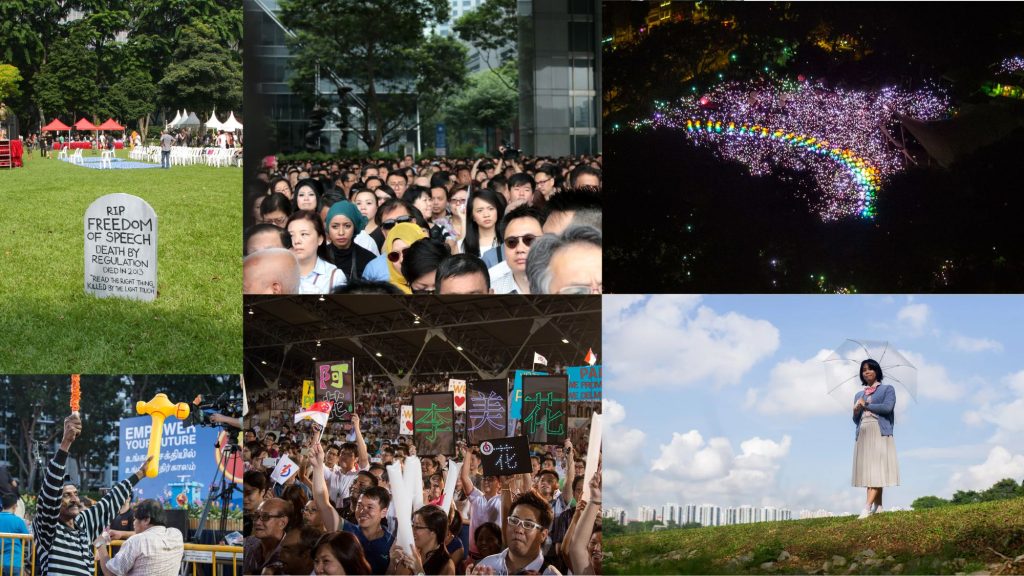
Thirteen years after I became a junior writer at The Online Citizen, I am now working to build digital communities — and contributing to a cosmopolitan ideal, a society that embraces difference.
For Gunawardana, social media has enabled her to amplify her voice and share her lived experiences. Even as her health forces her to step back, Gunawardana finds joy in the fact that she has connected with people through social media and helped advance conversations about colourism, media representation, diversity, and accessibility in Sri Lanka and across the world. To this day, she still notices people discovering her videos — some six or seven years old — and commenting on them, sharing their own experiences with discrimination. “We have a way of leaving a footprint that doesn’t need to stop,” she says. “And for me, that’s where the power lies.” She believes that it’s the little conversations that help push the needle on issues like colourism. “I think that’s the beauty of it. You just need two or three people to connect, and maybe you do change something.”
“I am not a leader. But I think of myself as a catalyst. As a journalist and communicator, I am a voice for the underserved. I am a platform for the leaders who seek to serve the communities I hold dear. I build bridges for society to come together. I tell the stories that matter.” – Ellis Ng, ellis’ island
Photos: Ellis Ng, Hillary Tan
Dialogue is key to stemming the tide of polarisation, stopping radicalisation, and bridging divides. We should see each other as people, not as political opponents, anonymous usernames, or bylines.
The work — to build bridges, to seek dialogue — continues, both in the digital space and in person. I still have that inherent belief in stories, a lesson I learnt from my mentor when I was 18. I believe that a good story will triumph.
And as long as we tell good stories, we will, too. ∞
ELLIS NG
Ellis Ng is a journalist and volunteer community advocate. Formerly a user-generated content producer at Reuters from 2018 to 2022, Ellis spent more than nine years with various Singaporean and global news outlets, including the South China Morning Post, China Daily, Mothership.sg, and The Straits Times.
AUGUST 2025 | ISSUE 14
SCREENS BETWEEN US
- Guesmi, Haythem. “The Social Media Myth About the Arab Spring.” Al Jazeera, 27 Jan 2021, https://www.aljazeera.com/opinions/2021/1/27/the-social-media-myth-about-the-arab-spring.
- Berkowitz, Ben. “From a Single Hashtag, a Protest Circled the World.” Reuters, 18 Oct 2011, https://www.reuters.com/article/ world/from-a-single-hashtag-a-protest-circled-the-worldidUSTRE79H3ZK/.
- Soo, Nikki. “Tweet Tweet: A Personal View of Social Media in GE 2011.” IPS Update, Institute of Policy Studies (IPS), Lee Kuan Yew School of Public Policy, National University of Singapore, Sep 2011, https://lkyspp.nus.edu.sg/docs/default-source/ips/nikki_apersonal- view-of-social-media-in-ge-2011_010911.pdf.
- Klee, Miles. “How Elon Musk and X Became the Biggest Purveyors of Online Misinformation.” Rolling Stone, 9 Aug 2024, https://www. rollingstone.com/culture/culture-features/elon-musk-twittermisinformation- timeline-1235076786/.
- Vanian, Jonathan. “Grok’s ‘White Genocide’ Auto Responses Show AI Chatbots Can Be Tampered With ‘At Will.” CNBC, 17 May 2025, https://www.cnbc.com/2025/05/17/groks-white-genocideresponses- show-gen-ai-tampered-with-at-will.html.
- Ortutay, Barbara. “Amnesty Report Finds Facebook Amplified Hate Ahead of Rohingya Massacre in Myanmar.” PBS News, 29 Sep 2022, https://www.pbs.org/newshour/world/amnesty-report-findsfacebook- amplified-hate-ahead-of-rohingya-massacre-in-myanmar.
- Marie, Antoine. “Is Social Media Fuelling Political Polarisation?” The Conversation, 19 Jun 2024, https://theconversation.com/is-socialmedia- fuelling-political-polarisation-232749.
- Marie, Antoine. “Is Social Media Fuelling Political Polarisation?” The
Conversation, 19 Jun 2024, https://theconversation.com/is-socialmedia-
fuelling-political-polarisation-232749. - Vosoughi, Souroush, et al. “The Spread of True and False News Online | Science.” Science.Org, American Association for the Advancement of Science, 9 Mar 2018, https://www.science.org/ doi/10.1126/science.aap9559.
- Klee, Miles. “How Elon Musk and X Became the Biggest Purveyors of Online Misinformation.” Rolling Stone, 9 Aug 2024, https://www. rollingstone.com/culture/culture-features/elon-musk-twittermisinformation- timeline-1235076786/.
- Idris, Ika. “Deceptive Trends: The Societal Impact of Disinformation on TikTok.” Australian Institute of International Affairs, 8 Aug 2024, https://www.internationalaffairs.org.au/australianoutlook/ deceptive-trends-the-societal-impact-of-disinformation-on-tiktok.
- Sadiq, Sheraz. “UW Study Reveals How Social Media Influencers Profit from Spreading Misinformation.” OPB, 19 Mar 2024, https:// www.opb.org/article/2024/03/18/think-out-loud-uw-study-socialmedia- influencers-misinformation.
- Vanian, Jonathan. “Misinformation Running Rampant on Facebook Has Officials Concerned about Election Disruptions.” CNBC, 26 Sep 2024, https://www.cnbc.com/2024/09/26/facebooksmisinformation- problem-has-local-election-officials-on-edge.html.
- Winner, Langdon. “Do Artifacts Have Politics?” Daedalus, vol 109, no 1, 1980, pp 121–36. JSTOR, http://www.jstor.org/stable/20024652. Accessed 22 Jul 2025.