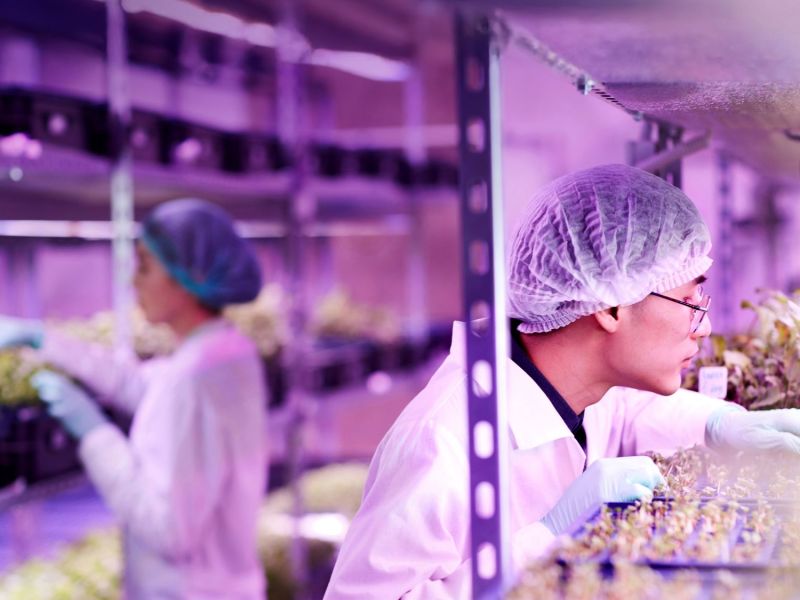


Food security, defined as sustained access to safe, sufficient, and nutritious food, is increasingly under strain, with direct and far-reaching implications for nutrition, human health, and well-being. Food insecurity is driven by a complex set of interrelated factors. Poverty remains a fundamental concern, further exacerbated by food-price inflation, inadequate infrastructure across the food production, transportation and supply chain, climate-induced droughts and floods, and limited access to critical resources, including arable land, water, and financial resources.
The magnitude of the problem is significant. According to the Food and Agriculture Organization (FAO) of the United Nations, 673 million people experienced hunger in 2024, while 319 million people faced acute levels of food insecurity across the 67 countries in which the organisation operates. These figures underscore both the scale and the urgency of the food security challenge, particularly in low- and middle-income countries.
Rooted nutrition
Biofortified orange-fleshed sweet potato has been introduced across parts of sub-Saharan Africa to combat vitamin A deficiency. Rich in provitamin A, it has significantly improved intake among children and women, reducing the risk of blindness and strengthening immune health.
Source: CGIAR
From a regional perspective, food insecurity is falling in Latin America and the Caribbean and increasing in Africa. It has been decreasing gradually in Asia for several consecutive years, while in Oceania and in Northern America and Europe, new estimates point to a slight decline. Globally, and in almost every region, food insecurity is more prevalent in rural areas than in urban areas and affects more women than men.
The main challenge lies in translating this knowledge into coherent, adequately financed, and effectively implemented long-term policies.
The challenge is not one of insufficient knowledge: substantial evidence, data, and technical solutions already exist to address multiple vulnerabilities along the food chain, from production to consumption. Instead, the main challenge lies in translating this knowledge into coherent, adequately financed, and effectively implemented long-term policies that can protect vulnerable populations, strengthen agrifood systems, and ensure sustained access to affordable, healthy diets for all irrespective of their income and purchasing power.
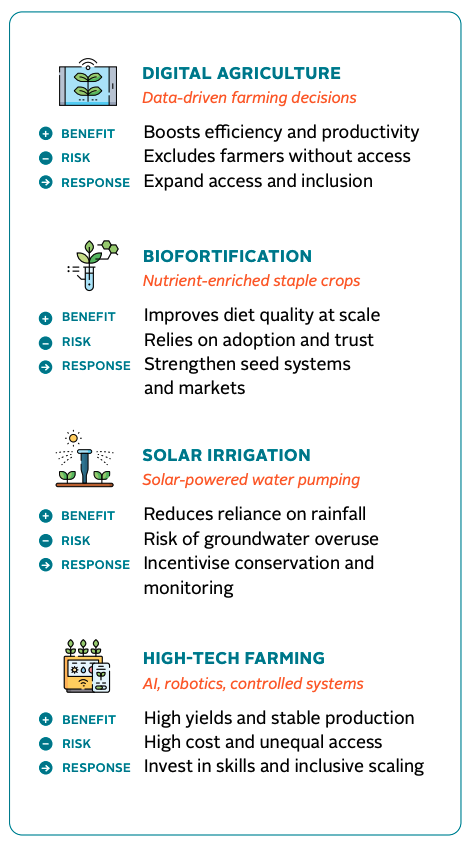
Several innovations in different parts of the world are contributing to improve food security at local levels. These range from digital agriculture and extension services that help smallholders make more timely production and input decisions, with global evidence showing the strongest outcomes around knowledge gains and practice change, to nutrition-sensitive crop innovation such as biofortified staples, eg, provitamin A-rich orange sweet potato and cassava interventions. Interlinkages have been evaluated through large- scale impact studies and linked to improved vitamin A intake and status among vulnerable populations. In parallel, renewable-energy irrigation is being deployed to reduce dependence on rainfall and expand productive capacity.
In this regard, FAO has highlighted the potential of solar irrigation to unlock agricultural growth in water-stressed regions, while India’s PM-KUSUM programme formalises a national pathway for scaling solar pumps and decentralised renewable energy to support farm operations. Finally, institutional procurement models, including home-grown school feeding and public purchasing from smallholders, create stable local markets that can strengthen rural livelihoods while improving access to food for nutritionally vulnerable groups.
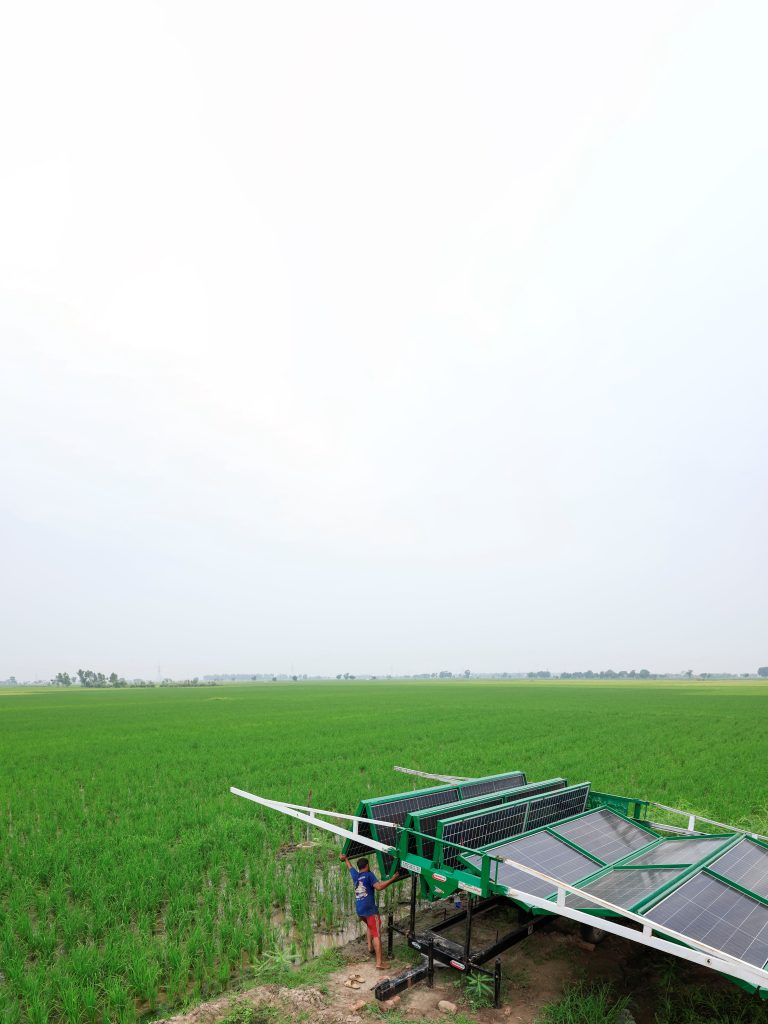
Panels and paddy
The solar boom has led many farmers in Pakistan to install solar- powered tube wells for irrigation. While offering cheap, clean energy, it has also accelerated groundwater depletion with little regulation, threatening long-term agricultural sustainability.
Photo: Akhtar Soomro / Reuters
As these innovations scale, the main risks that have been identified for their implementation can also be treated as design levers for improving effectiveness and equity. For digital advisory and other ICT-enabled services, a consistent caveat is that benefits can concentrate among users who already have reliable connectivity, access to electricity, devices, and time, often excluding poorer households and also women.
This points to the opportunity to pair digital tools with inclusion measures such as affordability policies, shared or public access points, and gender-intentional delivery models so that women and marginalised farmers can participate on equal terms. For biofortification, nutritional potential depends on sustained adoption and consumption but relies on dependable seed and planting-material systems, market availability, consumer trust and long-term funding. This turns the adoption constraint into an implementation opportunity that includes strengthening local seed systems, integrating biofortified varieties into procurement and value chains, and using credible nutrition information to increase consumer willingness to adopt and pay for nutrient-enriched staples.
For solar- powered irrigation, the widely discussed downside is that lowering the marginal cost of pumping can intensify groundwater abstraction in water-stressed areas, therefore, affecting the farmers over the long term. However, the same technology can be redirected toward conservation when coupled with incentives, especially mechanisms that enable farmers to earn by exporting surplus electricity to the grid creating financial incentives to pump less, alongside monitoring and locally enforceable groundwater management practices.
Another innovation is high-tech farming. As this has matured, evidence from countries in the global North and South shows measurable progress alongside substantial upside potential for food security and supply resilience. In developed agri- food systems, controlled environment agriculture including advanced greenhouses and indoor vertical systems, has expanded as a strategy for more predictable, year-round production and shorter supply chains. In Europe, public institutions describe rapid mainstreaming of precision technologies into machinery markets, an indicator of diffusion potential where farm structure, connectivity, and skills allow uptake.
In the Netherlands, high-tech greenhouse horticulture remains a core pathway for intensive, climate-controlled production, with Wageningen University & Research emphasising innovation trajectories toward more energy-efficient and ultimately climate-neutral greenhouse systems while maintaining, and even enhancing, yield and quality. In Japan, national policy has explicitly pushed smart agriculture like robotics and ICT to save labour and sustain productivity amid workforce decline.
The situation is different in countries in the global South, where the trajectory is slower. In India, NITI Aayog’s roadmap, for example, frames frontier technologies such as artificial intelligence, machine learning, IoT-enabled precision agriculture, drones, and satellite imaging as central to raising productivity and resilience by putting actionable data into farmers’ hands.
In East Africa, rigorous evaluation evidence also suggests that relatively low-cost high-tech interventions like mobile-phone extension that has been used before for water management decision- making, can reach large numbers of smallholders and improve practices, indicating a pathway for progress where capital-intensive automation has been slower to diffuse.
Despite this progress, several structural downsides must be addressed for high-tech farming to realise its full potential for food security and nutrition. A central concern is unequal access and capital intensity: many high-tech systems, such as advanced precision machinery, robotics, and controlled-environment agriculture, require substantial upfront investment and technical capacity, which can exclude small and medium-scale farmers and reinforce concentration in wealthier regions or among larger farms.
OECD analyses show that without targeted policies, digitalisation and automation in agriculture risk widening productivity and income gaps rather than reducing them. Skills and labour displacement are another challenge: while smart technologies can address labour shortages in ageing farming populations, studies also warn that insufficient training and advisory systems can limit effective use, and that automation may displace certain categories of agricultural labour if transitions are not managed through reskilling and inclusive rural development strategies.
Food insecurity is not inevitable but addressing it requires deliberate choices about how innovations are designed, governed, scaled, and implemented.
Environmental trade-offs also remain unresolved. For example, energy-intensive indoor and vertical farming systems can reduce land and water use but may generate high carbon footprints if powered by fossil-based electricity, a risk highlighted in life-cycle assessments of controlled-environment agriculture. Finally, data governance and ownership pose growing challenges: academic and policy reviews note that farmers often lack control over data generated by digital platforms and machinery, raising concerns about privacy, market power, and dependency on a small number of technology providers. Addressing these economic, social, environmental, and governance constraints is therefore essential if high-tech farming is to contribute equitably and sustainably to global food security in the coming decades.
Food insecurity is not inevitable but addressing it requires deliberate choices about how innovations are designed, governed, scaled, and implemented. The persistence of hunger and malnutrition, despite the availability of technical solutions, reinforces the core message that progress depends less on discovery than on implementation, coordination, inclusion and long-term commitment. Innovations in digital agriculture, biofortification, renewable-energy irrigation, and high-tech farming demonstrate tangible gains at local and national levels, yet their impacts are highly contingent on enabling conditions such as functioning institutions, resilient infrastructure, skill upgrades, and governance frameworks.
From a future perspective, the key opportunity lies in integrating innovation with systems-level safeguards. It is necessary to embed equity considerations like affordability, gender inclusion, and smallholder access, directly into technological introduction, rather than treating them as afterthoughts. Similarly, environmental risks associated with intensification and automation, including groundwater depletion and high energy use, underscore the importance of coupling innovation with strong natural resource governance and climate-aligned incentives, as highlighted in research on solar irrigation and controlled-environment agriculture.
The future potential of high-tech and low-tech innovations alike depends on policy coherence and public investment. Evidence from developed and developing countries suggests that when governments align agricultural, energy, digital, and social protection policies while investing in human capital and data systems, innovations are more likely to translate into durable food security and improved nutrition outcomes. In this sense, innovation should be understood not as a substitute for public action, but as a multiplier of it.
Achieving sustainable food security in the coming decades will therefore hinge on whether existing knowledge and technologies can be mobilised through inclusive, well-governed, and forward- looking food system strategies that place nutrition and well-being at their core. ∞
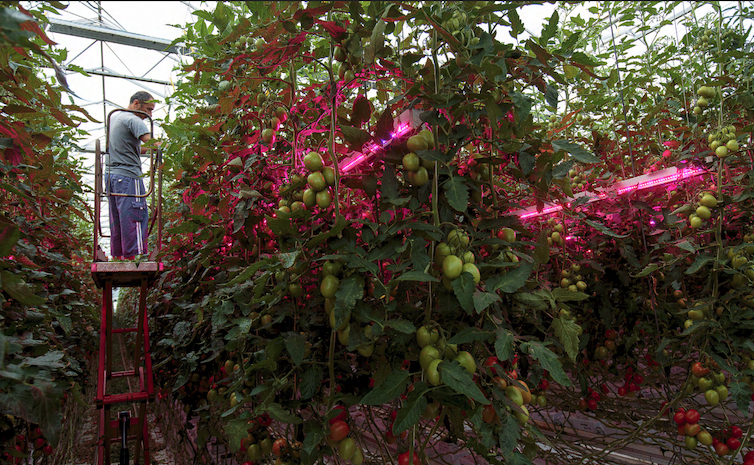
12x more tomatoes
In the Netherlands, climate-controlled greenhouses produce up to 12 times more tomatoes than the global average, using precision technology to maximise yield while reducing water — just 4 litres per kilogram compared to over 200 litres globally — though at high energy and capital costs.
Photo: Michael Kooren / Reuters
PROF CECILIA TORTAJADA
Prof Cecilia Tortajada is Honorary Professor in Practice at
the School of Social and Environmental Sustainability, University
of Glasgow, UK and Adjunct Senior Fellow at the S. Rajaratnam School of International Relations, Nanyang Technological University, Singapore. She is also a Visiting Professor at Beijing Normal University and Chang’an University, China. Prof Tortajada serves on several distinguished bodies, including the Millennium Technology Prize Selection Committee, the UKRI Future Leaders Fellowships Peer Review College, and the OECD Initiative on Water Governance.
PROF ASIT K BISWAS
Prof Asit K Biswas is a Distinguished Visiting Professor at
the University of Glasgow, UK. He serves as Director of the Water Management International Pte Ltd, Singapore, Chief Executive at
the Third World Centre for Water Management, Mexico, and Visiting Professor at Beijing Normal University, China. Prof Biswas is also the author or editor of 89 books, and his work has been translated into 42 languages.

2026 | ISSUE 15
THE FIGHT FOR (GOOD) FOOD