In an era where sustainability is now a matter of survival rather than a corporate buzzword, food waste has become a necessary part of the conversation. We spoke with Dr Kwan Lui, Founder of At-Sunrice GlobalChef Academy and WellSpent Upcycling to get a glimpse into the heart of her innovative food upcycling business and how she plans to expand its philosophy.
Waste by design
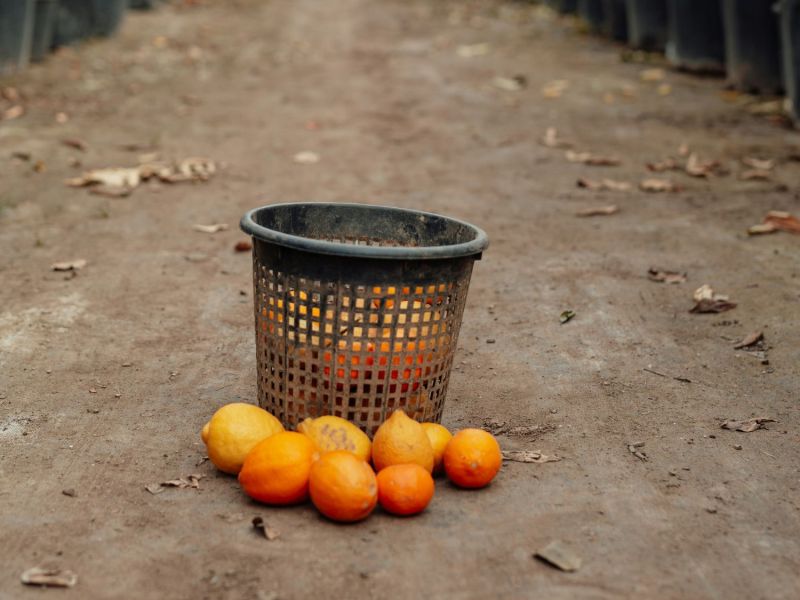
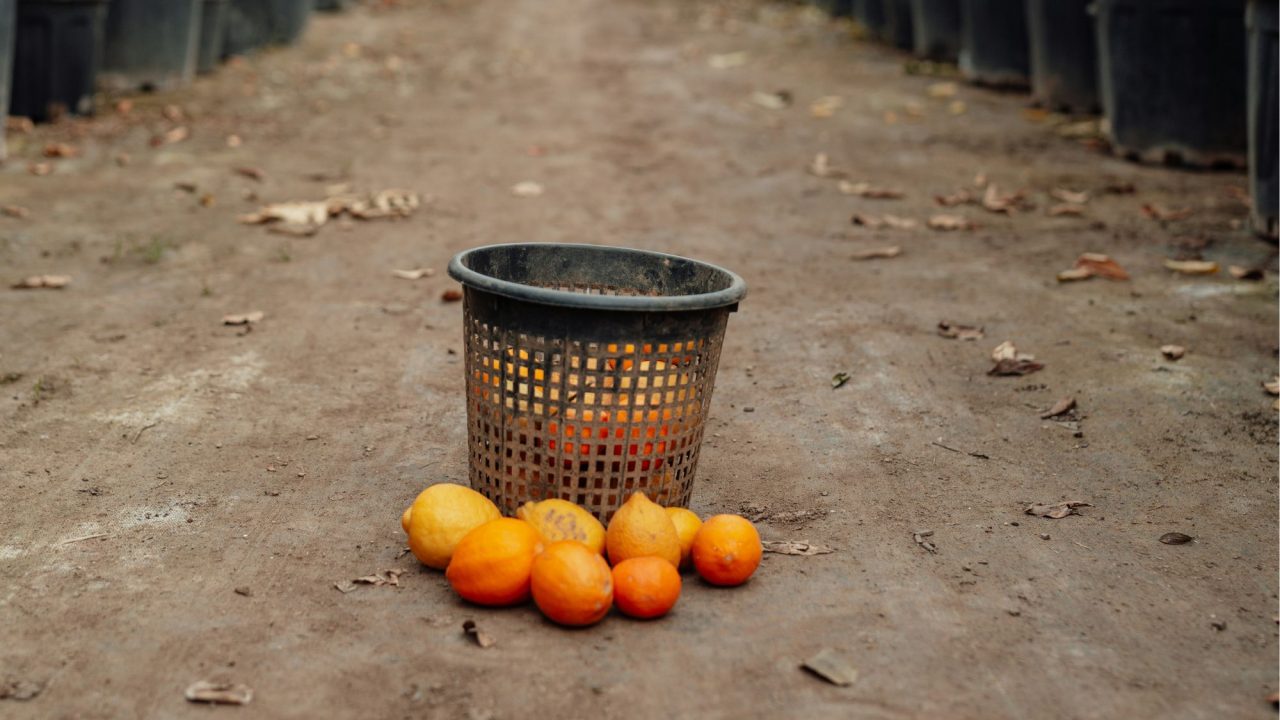
A significant share of food loss occurs before it reaches consumers, with around 13% lost between harvest and retail. During manufacturing, edible materials are routinely trimmed, separated, or discarded as by-products, alongside losses from inefficiencies and quality control. Photo: Ahmet Kurt / Unsplash
Could you share how your interest in food upcycling began, and how it connects to your work at At-Sunrice?
We started WellSpent about five years ago. I didn’t like the word “waste” because it has a negative connotation. When I found the word “spent,” which means food that has already been processed once before, a lightbulb went off in my head. I also like the notion that one’s money is spent well, twice. That’s how the name came about.
When I started At-Sunrice, I wasn’t a chef. I was just someone interested in food, cuisine, and education. Those were my three words for my retirement venture.
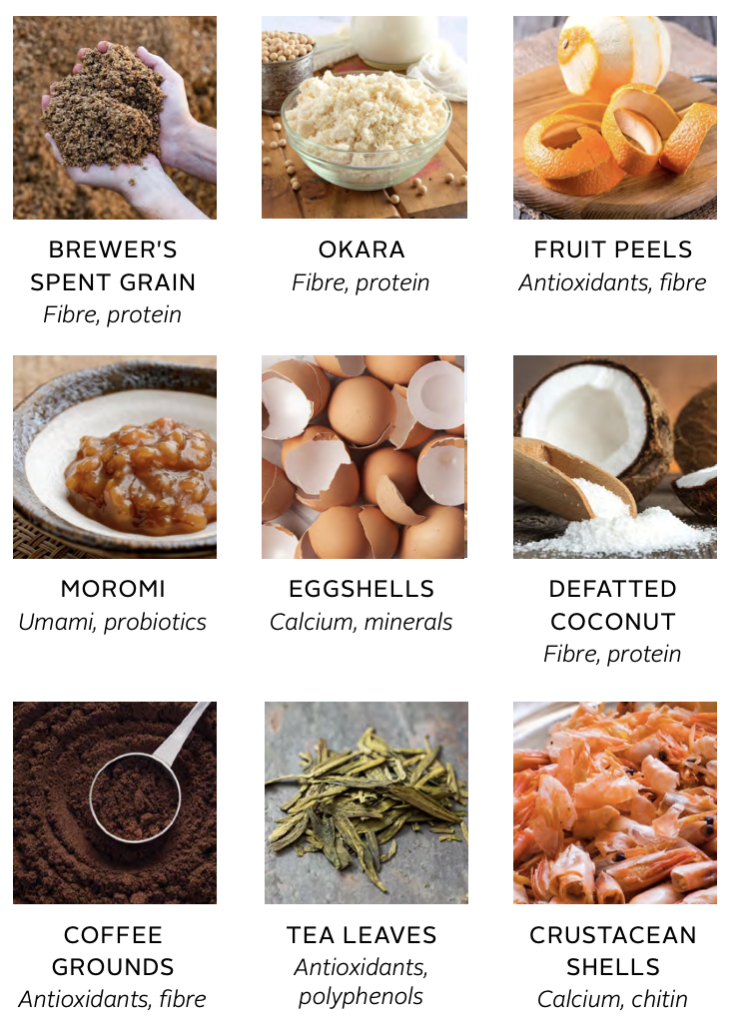
For 24 years, we’ve been teaching culinary arts, and you quickly learn that many food waste streams, like okara, moromi, orange peel, or even eggshells, are still highly nutritious. They’re thrown away mainly for convenience, not because they lack value.
As a culinary school, we buy, we cook, we serve, we eat, and we throw. That’s the chain. Then I asked, how do we then make it circular? And so, this was the inspiration.
I’ve always emphasised gut health, fibre, and whole foods. So upcycling was about applying what we al- ready know to reduce waste, improve nutrition, and create new products that taste good.
What philosophy guides your upcycling work at WellSpent?
The idea is circularity. We want to show people that many so-called “waste,” sidestreams or spent ingre- dients, are actually nutrient-rich and flavourful. Why let it go to waste if humans can still benefit from or consume it?
Many sustainability efforts divert waste into animal feed, compost, or fuel. That’s fine, but I think the highest value use is still human consumption.
Upcycling is not only about sustainability or food security; it’s about public health and nutritional quality. What you throw away should come back to nourish you.
Upcycling is not only about sustainability; it’s about public health and nutritional quality. What you throw away should come back to nourish you.
From Waste to Value
Spent ingredients as functional nutrients
What are some challenges or barriers specific to upcycling?
When we speak with other food waste recycling companies, there’s always a question of collection and transport. There’s a cost to collecting food waste, even things that are thrown away from bak- eries every night.
Moreover, upcycling requires more effort and processing, so public adoption is very slow. Ideally, we would like to achieve institutional feeding to army camps, schools, hospitals etc.
Can upcycling truly be a profitable business? What does the upcycling process look like at WellSpent?
Yes, it can be profitable because the government usually subsidises it at a certain scale. If I could, I would want to create just one product: for example, the Orange Peel Magic. I would upcycle the orange peel and sell it. But because we are a culinary academy, I decided to create a range of products as well.
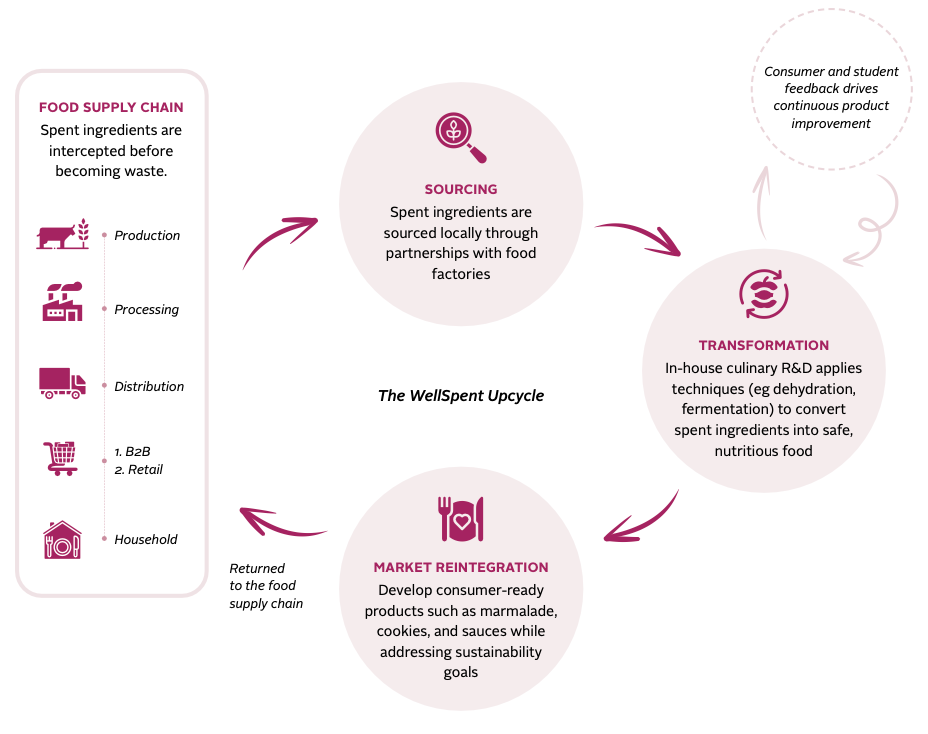
We have an ecosystem set up from point A to Z. We source spent ingredients locally by partnering with factories that we know have ample supply. All of the spent conversion, R&D, cooking, fermenting, baking, quality control, and testing are done in-house.
We take quality control very seriously as well. We tightly monitor hygiene, volume consistency, nutri- tional, and ingredient stability.
Then, we sell the ready-to-ship products via our own ecommerce platform and others like Shopee. We do this to ensure that the entire value chain maintains integrity.
The citrus magic
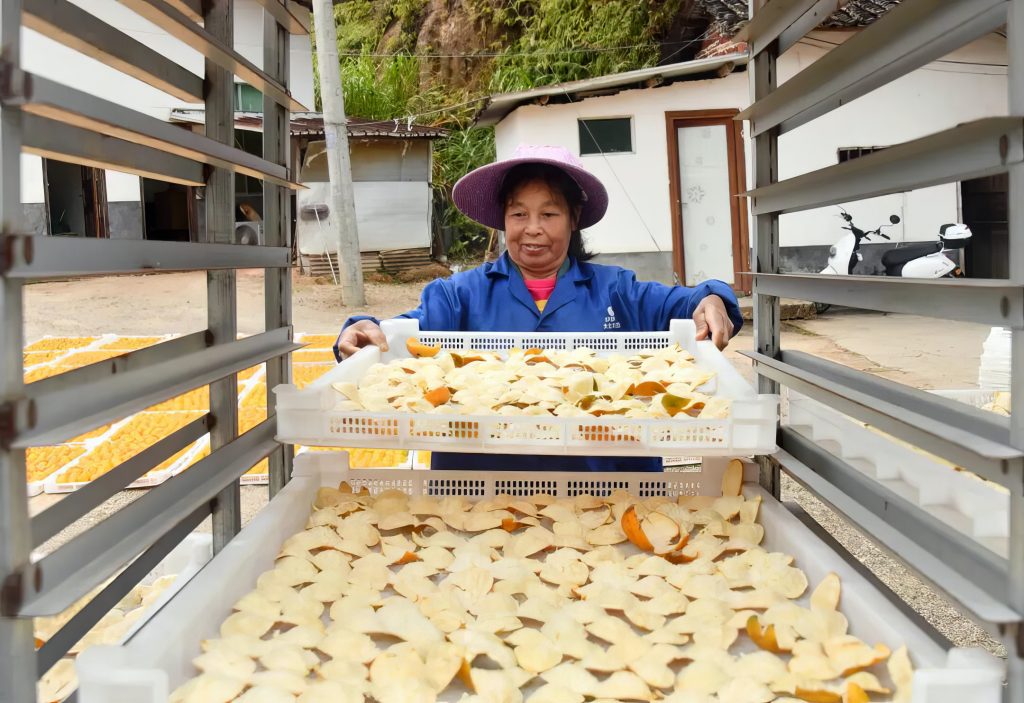
Tangerine peels, often discarded, are dried into chenpi, a key ingredient in traditional Chinese medicine. It is used to regulate qi, aid digestion, reduce bloating, and help relieve coughs and phlegm, and is also commonly used in Chinese cuisine.
Source: dingnan.gov.cn
What does the upcycling landscape look like internationally?
It’s still in its early stages. In Japan, okara and moromi are used as products, but rarely in finished consumer goods. In the US, there are small initiatives, but nothing at scale.
What we’re doing — culinary-led upcycling into ready-to-ship products — is still quite rare. However, since it’s not difficult to replicate, I’m worried that people will not really promote the mission but try to commercialise it.
My long-term plan is to license or franchise our upcycled product lines to local manufacturers around the world... Export the knowledge, not the product.
A tradition of using what remains
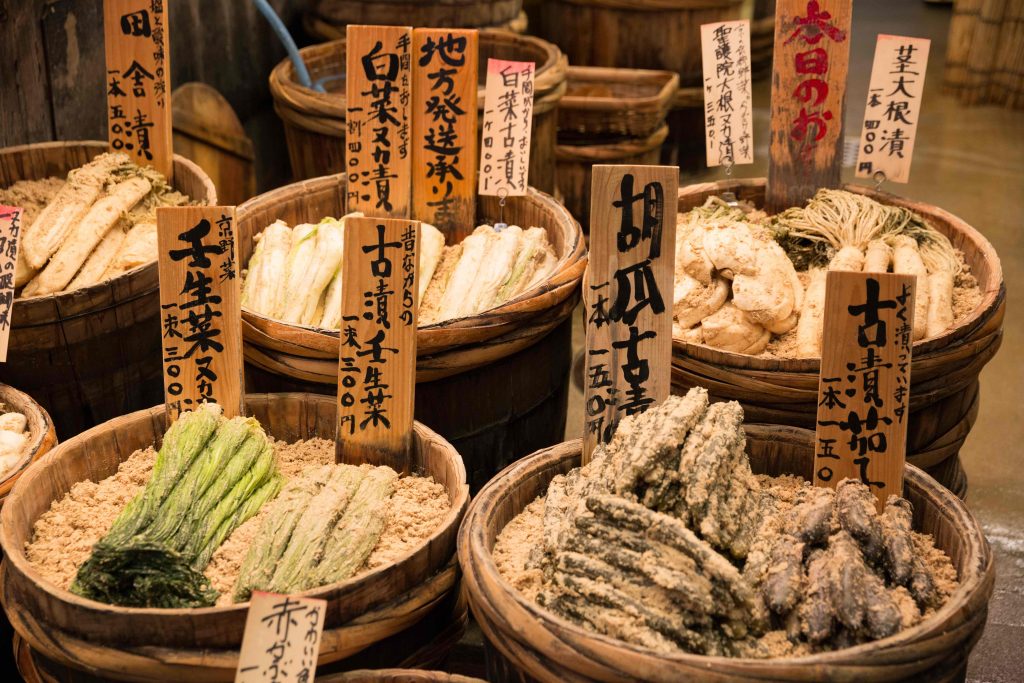
In Japan, concepts such as mottainai (don’t waste) are part of everyday cooking, where by-products are routinely used. Nukazuke, a vegetable pickle fermented in rice bran — a by-product of milling — is one example, developed in response to vitamin B1 deficiency during the Edo period.
Photo: winhorse / iStock
What challenges do you face when trying to scale upcycled food production?
We’ve exhibited at food shows and received some regional attention and interest. However, I decided not to continue because I’m still very idealistic at this point. I hope to build and maintain an ethical, sustainable circular ecosystem.
Once you scale, you face storage needs, warehous- ing, logistics, preservatives, and food safety stan- dards. And ironically, if you start shipping upcycled products overseas, you may increase your carbon footprint, which defeats the point.
That’s why we have designed a licensing-franchise model that enables us to license our recipes and pro- cesses to local manufacturers around the world. We believe in exporting the knowledge, not the product.
My long-term plan is to license or franchise our up- cycled product lines to local manufacturers around the world, instead of exporting the food itself. Ex- port the knowledge, not the product.
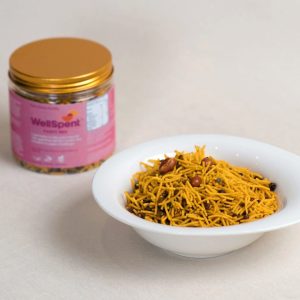
Barley + murukku = Party Mix
Reimagining a classic snack, WellSpent’s Party Mix uses upcycled brewer’s spent grain and eggshell mala sea salt, combining waste reduction, nutrition, and taste in everyday food production.
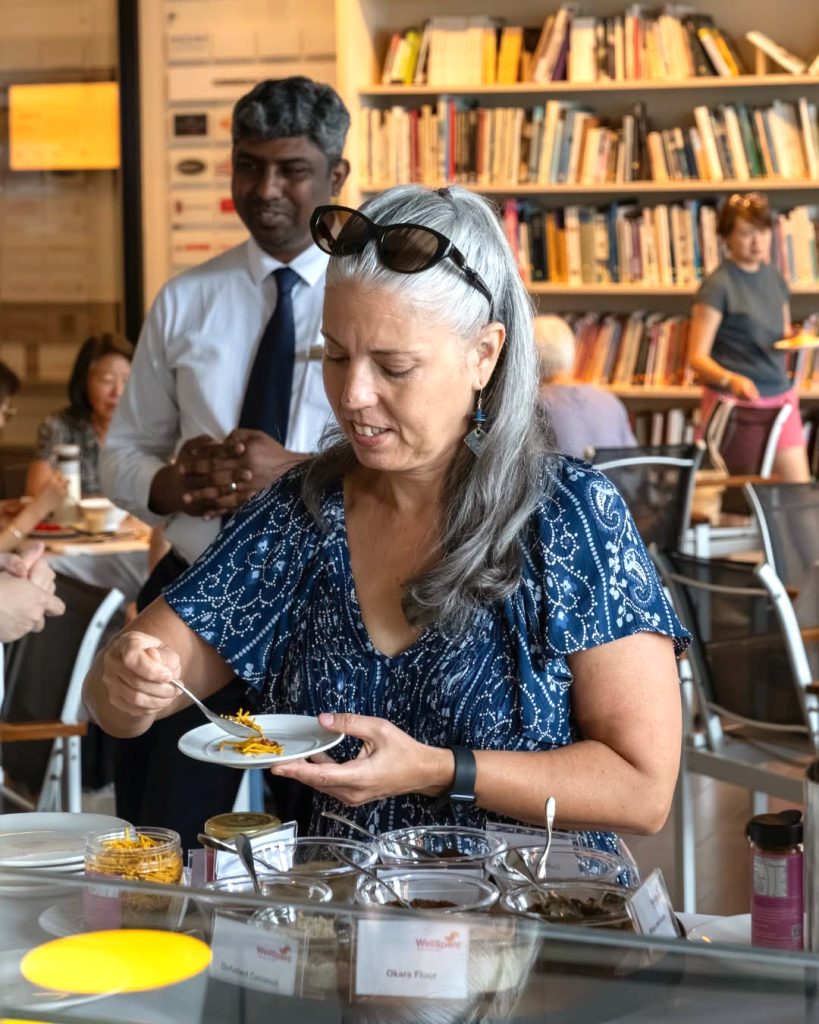
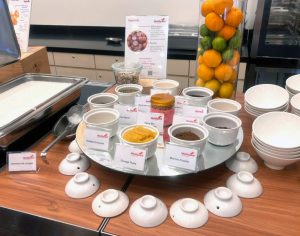
Happy Gut Stop Breakfast
Open to public participation, the Happy Gut Stop Breakfast event presents an assortment of fibre-rich, probiotic- and prebiotic-packed dishes, promoting gut health and everyday nutrition.
How does your approach to R&D differ from scientific or laboratory-driven upcycling models?
We are a culinary school, so our R&D focuses on flavour, texture, and usability. We don’t work to prove that foods like tofu (or its byproduct, okara) are nutritious, because we already know they are.
We don’t work from the scientific side of “validate first, process later.” We work from the culinary side: “develop first, improve continuously.”
Our R&D is primarily product development. We work to improve the taste, texture, and, of course, the nu- trition. We don’t add too much sugar or salt. We try to rely on natural, spent ingredients like eggshell salt or moromi, which enhances the umami flavour.
We use a hands-on approach, asking questions like, “what percentage of a spent ingredient can we in- clude because it affects taste?”
Our okara cookies have evolved over the years. We started with a relatively small amount first, before slowly introducing a larger percentage of spent with subsequent generations. We’ve become more confident over the years after learning that people are willing to eat more of the spent, and that they also seem to like the taste.
I love 老婆饼 (lao po bing, wife cake). I came back from Hong Kong last week with a box of it. The filling is winter melon, and the lao po bing usually contains a lot of animal fat and sugar. But I’ve asked the chefs to create a version that uses our Orange Peel Magic as the filling. So, we’ll have a tasting session later this week with this new Orange Peel bing.
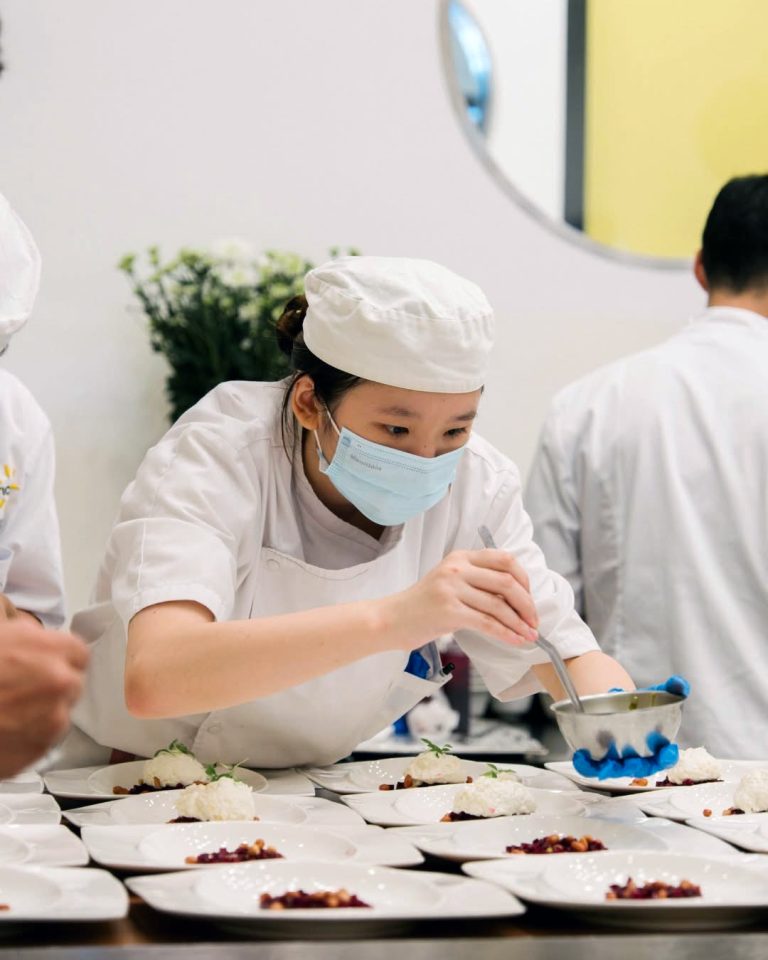
The upcycled table
At-Sunrice’s Luxe Series features themed cooking and tasting sessions where guest chefs work with upcycled ingredients, offering a closer look at how spent ingredients are incorporated into creative and flavourful dishes.
Source: WellSpent Gourmet2Go facebook
What are your hopes for the future of upcycling?
I hope to see the upcycling ecosystem become more circular. Idealistically, everything should be relatively local. Instead of shipping upcycled products across continents, we should empower people everywhere to upcycle their own waste sidestreams.
I want to see a new generation of culinary innovators who can turn food waste into high-value products; people trained not just in cooking, but in nutrition, R&D, and circular thinking.
Our role is to build the ecosystem; from waste, processing, formulation, product development, to training and licensing. That’s the future I hope to contribute to.
What does sustainability look like at At-Sunrice?
We’re cautious about our food waste here in At-Sun- rice. We’re careful about how much we buy, how much we cook, how much we use and consume, so we try not to serve or cook too much.
We don’t use our own food waste for the work we do with WellSpent, because the supply chain may not be as reliable. When you work with spent ingredients, you need a consistent volume. That’s why we source from food factories, not our own kitchens.
What type of programmes do you run in At-Sunrice?
We run diploma programmes in culinary, pastry bakery, specialist diplomas in food entrepreneurship and culinary wellness as well as a bachelor’s degree in business entrepreneurship. We also have food safety and continuous education programmes, which are open to everyone. We offer private chef classes, and other leisure and creative classes with no prerequisites. Some of our courses include Creative Patisserie, Baking Café-style Bread, Chocolate Confections, Dim Sum Dishes, and Discover the World of Wine.
We once had a clan come over to take a course together. They said, Wow, this was such a good ex- perience for us because now the clan is so close. You know, those who eat together, stay together, right?
We’re seeing more career changers, including retirees and mid-career professionals, interested in learning about upcycling and healthy food development.
From 2026, subsidies may become more targeted, so only industry professionals may be eligible for funding. But we’ll continue designing programmes that blend cooking, nutrition, and sustainability.
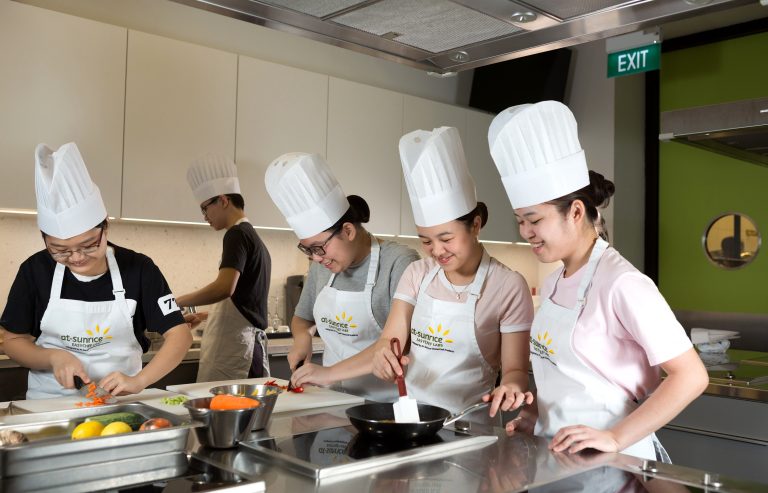
Anyone can cook
An experiential learning space, EasyChef Lab brings together participants of all backgrounds for hands-on cooking sessions focused on cuisine, nutrition, and sustainable food practices, while fostering social bonding.
Source: At-Sunrice website
Among the many upcycled products you’ve developed, which stand out to you?
My favourite has got to be the Orange Peel Magic. It’s actually the first product we developed at WellSpent — we initially called it Orange Peel Marmalade. We quickly discovered that we could use it as an ingre- dient in all sorts of our dishes. It was so versatile, we decided to rename it Orange Peel Magic.
I also like our eggshell sea salt, which is naturally low in sodium but still full of minerals; moromi chocolate cake, which uses fermented by-products for deep umami; gluten-free cakes (developed at the request of JP Morgan); and spicy sauces made from green mango peel.
Many of our spent ingredients and products are gut-friendly, high-fibre, and high-protein. We also have our savoury foods, for example, the butter chicken or the lamb shank, which come in a cook- chill. We try to make it as clean and convenient as possible.
Because we’re based out of At-Sunrice, we have hundreds of students to help us taste-test. Therefore, our feedback loop is quick.
If we take care of our health, we’ll have a good, good life for years, instead of years to life. We need to rethink what “healthy” really means, especially for the next generation.
Many people assume healthy food is expensive. What are your thoughts on nutrition and public health in Singapore today?
As a developed country, we have more choices than ever. It also means that a lot of us have less physical activity as a result. Chronic conditions like diabetes and mental stress are rising.
Processed foods and artificial sweeteners are a real concern. Artificial sugars are especially bad for the gut microbiome, as they cheat it into thinking that it’s not real sugar. These have substantial consequences on the gut microbiome and even the brain. And because they are marketed aggressively, people think they’re safe with ‘healthier choices’ when they’re not.
A few days ago, I read an article about full-cream milk and how it’s more nutritious than skimmed milk. Skimmed milk is a little more expensive because another process removes the fat. However, healthier options tend to be indeed more expensive. It takes the whole value chain to really promote a few ingre- dients to become common, more affordable ingredi- ents. And of course, the government can definitely promote as well.
We are super agers in Singapore. If we take care of our health, we’ll have a good, good life for years, instead of years to life. We need to rethink what “healthy” really means, especially for the next generation. ∞

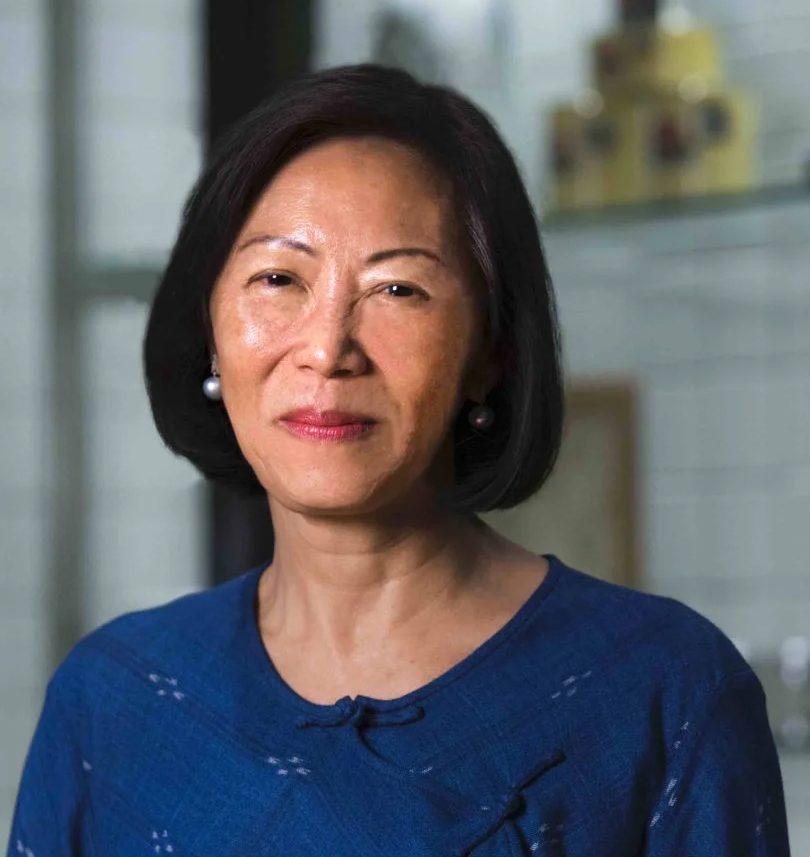
DR KWAN LUI
Dr Kwan Lui is an entrepreneur and educator, the founder of numerous companies, educational institutions, and well-known product brands. Born in Myanmar, she has lived in Hong Kong, Thailand, and the USA before settling in Singapore, where she resides.
In 2001, Dr Lui founded At-Sunrice GlobalChef Academy, a premier cooking and baking school in Singapore that offers an education-to-career pathway for young people in Asia to pursue their aspirations of becoming global chefs. The academy has since welcomed students from over 35 countries.
Dr Lui also founded WellSpent Upcycling, which upcycles fibre- and nutrient-rich food products. It hosts monthly “Saturday Luxe” events featuring gourmet meals, a produce market, interactive workshops, and more to promote sustainability, food security, and gut health.
2026 | ISSUE 15
THE FIGHT FOR (GOOD) FOOD