

Unlike traditional Blue Zones, Singapore is often described as an engineered Blue Zone, one shaped by deliberate government policies, urban planning, and food systems rather than by geography or long-standing tradition. From Healthier Choice Symbols on food packaging and NutriGrade labelling to active ageing centres, the promotion of local food production, and widespread health campaigns, the intent is clear: to nudge the population towards healthier choices.
Engineering longevity
From a life expectancy of 65 in 1960 to over 86 today, Singapore has been described as a “Blue Zone 2.0”, where longer lives are driven by sustained public policy and planning.
Photo: Chua Zi Hui / Unsplash
We also take pride in our medical advances and a healthcare system that excels at managing chronic diseases. Singaporeans are spoilt for choice when it comes to health monitoring tools — Healthy365, Health Discovery+, HealthTrack SG, Amped, and more. With all these systems firmly in place, one has to ask: how is it that our population remains at high risk of sarcopenia? (Data from Tan Tock Seng Hospital’s Integrated Geriatric Assessment highlights this growing concern.)
Sarcopenia refers to the progressive loss of skeletal muscle mass, strength, and function. It significantly increases the risk of frailty, falls, and loss of independence, affecting daily activities such as climbing stairs, walking, and even basic mobility.
Today, nearly 50% of the older adult population lives with at least one chronic condition and is highly aware of their health status.

A slow, silent loss
After age 30, adults can lose 3–5% of muscle mass per decade, with the rate accelerating after 50. Even small losses can have outsized effects, as declines in muscle strength and function often exceed the rate of muscle loss.
Photo: Lim Weixiang — Zeitgeist Photos / iStock
So, the question inevitably arises: Are we truly living up to the ideals of a Blue Zone, or are we simply living longer with a poorer quality of life?
As a nutritionist working through Singapore’s early struggles with rising chronic diseases, I witnessed firsthand how aggressively we fought against diabetes. Public health efforts have been highly effective in raising awareness about diabetes, cholesterol, and hypertension. Today, nearly 50% of the older adult population lives with at least one chronic condition and is highly aware of their health status.
However, this awareness has come at a cost.
In my conversations with individuals managing chronic diseases, a common theme appears: fear. Many become overly cautious. They proudly share how they have lost weight by cutting back on rice intake, avoiding their favourite high-fat meats, and consuming fewer calories overall.
The National Steps Challenge was also a success story, with many clocking 10,000 to 15,000 steps
a day, earning points, rewards and better health. It became a lifestyle. For those with higher BMI, weight dropped and often settled within the “healthy” range.
But as they aged, many noticed something unsettling. Weight began creeping back despite walking more and eating less. Fatigue set in more easily. Physical recovery slowed. Something was no longer working the way it once did.
One case still stands out vividly.
An elderly man, aged 60, with a family of four, contacted me to discuss his cholesterol results. Despite drastically cutting back on hawker food and reducing his rice intake, his numbers were not improving as much as he had hoped. He had lost a substantial amount of weight but felt increasingly weak and joyless around food.
The more he restricted himself, the more he believed something was wrong with him.

Starting sooner than we think
A Singapore study found sarcopenia present in 6.9% of young and middle-aged adults, highlighting its early presence and links to low muscle-strengthening activity, inadequate protein intake, and sedentary lifestyles.
Photo: joyt / iStock
Sarcopenia is often considered a condition of old age, but muscle loss can begin much earlier — sometimes as early as 35.
In reality, he was malnourished not due to a lack of discipline, but because of fear. His muscle loss had progressed to the point where he felt unwell, reinforcing his belief that he needed to restrict even further. This is how a vicious cycle begins.
Sarcopenia is often considered a condition of old age, but muscle loss can begin much earlier — sometimes as early as 35, when growth and regenerative capacity begin to decline.
Beyond calories
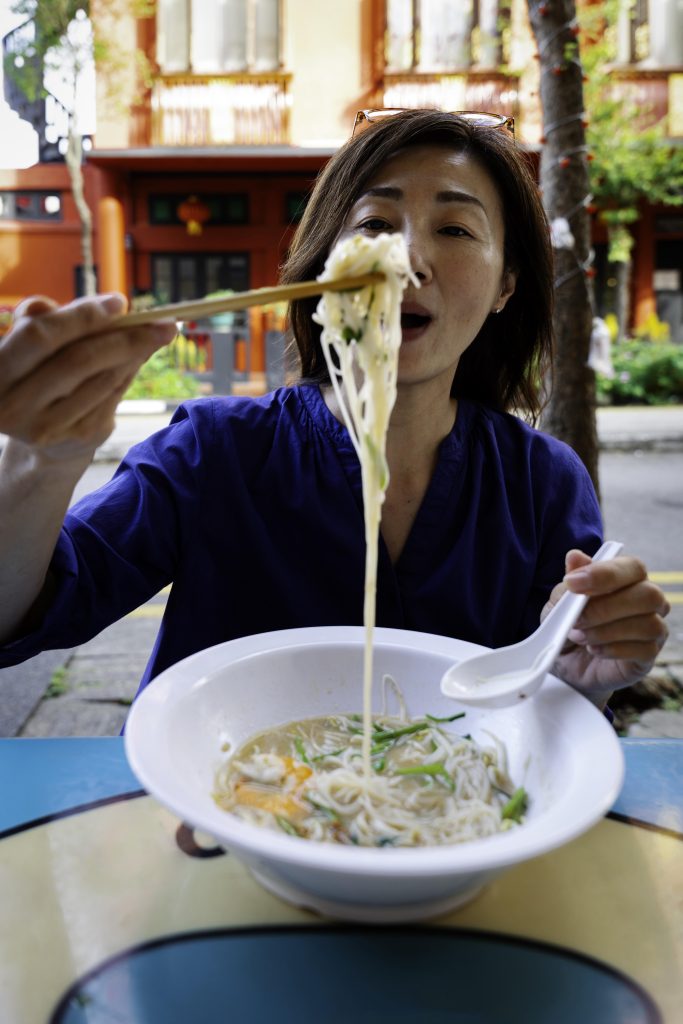
Prawn bee hoon soup is often seen as a lighter hawker option, but meeting the body’s protein needs for muscle health requires more than choosing lower-calorie meals.
Photo: redonion1515 / iStock
When food intake — particularly protein and total energy — is chronically low, and when physical activity is either insufficient or excessive without adequate recovery, the body adapts. Muscle becomes expendable tissue.
As we age, recovery slows, and cellular repair becomes less efficient. Malnutrition today does not always manifest as being skinny or underweight. Many individuals maintain a normal or even slightly elevated BMI and still appear healthy on the surface.
Over the past decade, health trends have increasingly demonised sugar, refined carbohydrates, and rice, often portraying them as the primary drivers of weight gain. Entire populations have experimented with no-carb or ultra-low-calorie diets to improve metabolic health.
At the same time, we witnessed a surge in endurance events and high-intensity fitness culture — marathons, cycling, HYROX, Spartan races, and relentless cardio-based training. An increasing number of individuals now train intensely but struggle to improve their performance or body composition. Many wonder why they feel constantly fatigued despite “doing everything right.”
The missing element is often nutrition literacy.
Without understanding how food fuels training and recovery, many unknowingly catabolise their own muscle mass. They train harder, eat less, and end up depleted.
Consider a runner whose caloric intake only meets basic daily energy needs. The intake did not account for sufficient protein and carbohydrates to support his or her running activity. Such a shortfall may hinder recovery and cause a deficiency in muscle growth. When the body runs on reserves, muscle tissue is sacrificed first.
As a result, despite being slender and physically active, a person’s body fat percentage may be higher due to muscle mass depletion. With age, agility declines, joint pain increases, and resilience weakens. Often, these changes go unnoticed until a fall, fracture, or sudden decline in health occurs.
Preventing malnutrition begins with meeting total caloric needs with an appropriate balance of protein and carbohydrates to support one’s lifestyle, in line with daily energy expenditure. From there, protein intake becomes essential.
Without understanding how food fuels training and recovery, many unknowingly catabolise their own muscle mass. They train harder, eat less, and end up depleted
According to the guidelines of the Health Promotion Board:
• Adults aged 18–49 require approximately 0.8 g of protein per kg of body weight
• Adults aged 50 and above require 1.2 g per kg of body weight
This means:
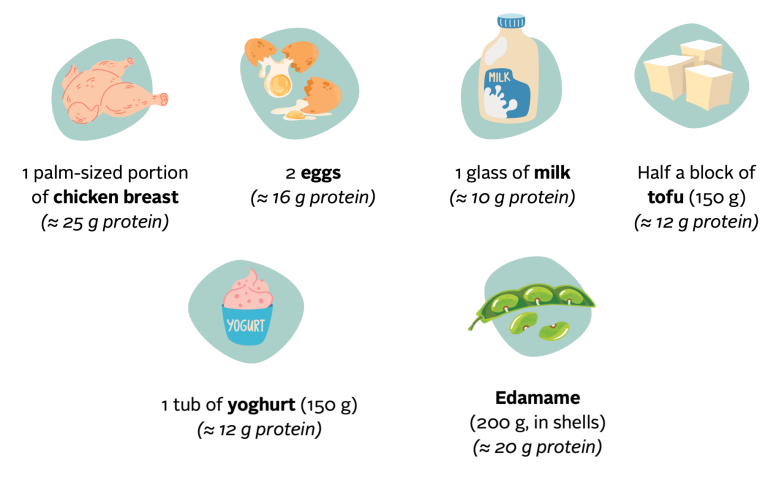
• A woman weighing 65 kg aged 50+ requires approximately 78 g of protein daily
• A man weighing 75 kg aged 50+ requires approximately 90 g of protein daily
In practical terms, this might resemble:
Eating adequately often requires nutrition literacy, basic cooking skills, and greater financial and time resources — barriers that cannot be ignored.
One of the main challenges in ensuring protein sufficiency is practicality. Many middle-aged adults no longer cook regularly; instead, they rely heavily on dining out or food delivery.
Hawker meals — economical and culturally cherished — are fundamental to the Singaporean diet. Wanton noodles, chicken rice, ban mian, char kway teow, Hokkien mee: these dishes are carbohydrate-heavy, with limited protein in both quantity and quality. Eating adequately often requires nutrition literacy, basic cooking skills, and greater financial and time resources — barriers that cannot be ignored.
Singapore is a pragmatic and financially savvy nation. As retirement ages extend, the question is no longer whether we will live longer, but how we will live.
Will we continue to enjoy marathons, golf, caring for grandchildren, social activities, and independence? Or will we simply extend life, while quietly losing strength, resilience, and joy?
Longevity without capability is not success. Strength, nourishment, and function must become central to how we define healthy ageing — before frailty becomes the unintended consequence of discipline. ∞
FIONA CHIA
Fiona Chia is a Singapore-based nutritionist and founder of Health Can Be Fun, a consultancy that combines nutrition science with behavioural insights to make healthy eating practical, culturally relevant, and sustainable. Her work spans public health initiatives, corporate wellness programmes, and individual nutrition care, with a focus on healthy ageing, muscle health, and the unintended consequences of fear-based dietary restriction. She writes and speaks on how food systems, health messaging, and lifestyle habits shape long-term health and resilience.
As a new mother, Fiona’s work has taken on renewed focus. She is committed to supporting women through life transitions, from perimenopause to pregnancy and early motherhood, advocating nourishment, strength, and confidence over restriction, and positioning nutrition as a foundation for vitality and longevity.

2026 | ISSUE 15
THE FIGHT FOR (GOOD) FOOD